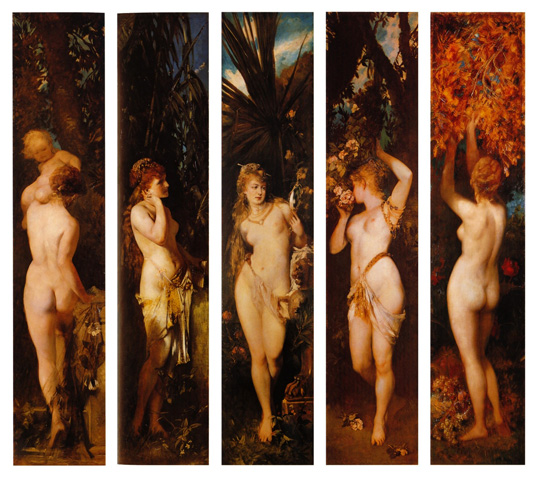
Saturday, 30 April 2011

Sensory Perception or Deception?

The Scottish poet Norman MacCaig (1910-1996) describes how “...into my, and your, five ports of knowledge come many cargoes and we should unship the lot.” (MacCaig, 1979, p84) While we have five senses and they bring us everything we know of the world, they can also prove unreliable and deceptive. Our brains can play “tricks” on us, send conflicting messages, and can misunderstand or misinterpret what the senses pass to them. However, for many people the senses can be damaged or manipulated by others causing them considerable difficulties in understanding or coping with the world they inhabit. I plan to examine how sensory perception is not to be depended on, can be unreliable and can be positively reordered by the intervention of others.

For example, it is widely thought that the illusion of depth in illustration was first developed in the Renaissance with Giotto’s ‘Jesus Before the Caïf’. However, Lascaux, a complex of caves in southern France, demonstrates through its cave-paintings that its unknown, prehistoric artists had their own grasp on perspective: they even used the natural curving and jutting of the cave walls to convey depth and movement. Artists have, then been ‘tricking’ our visual perception for thousands of years, from the times of the so-called primitive Neanderthals to the present day. And we seem to like it, as the popularity of, for example, Escher’s visual conundrums testify.

Sight is obviously one of our strongest senses, in use every minute of the day until we fall asleep (but even our dreams operate in a visual world); however, it can be demonstrated that the senses of touch, hearing, smell and taste are equally capable of being deceived. For example, we are familiar with eating a packet of Starburst sweeties without looking at the wrappers; your taste buds might tell you that you are eating something with the flavour of lime but when you look at the wrapper it tells you its flavour in fact is strawberry.

The day to day tricks and illusions created by our brains and senses are very powerful. So what must it be like to be sensorily impaired or deprived. What do we know of the 'pathology' of sensory malfunction? I will look at a number of areas where individuals are faced with significant sensory problems: for example, deliberate sensory deprivation (both willing and enforced); deprivation due to trauma; autism and, finally, the fairly common condition known as Attention Deficit Hyperactivity Disorder (ADHD).


Sensory deprivation is a controversial subject, with allegations the technique has been used in numerous detainment facilities such as, Guantanamo Bay as an interrogation tactic. Thousands of prisoners around the world are kept in solitary confinement, often with a severe level of sensory deprivation. It is thought that sensory deprivation can make people much more open to suggestion . During experiments in this area most subjects would give up non-compliance after 72 hours as the boredom and oppression of the conditions became overpowering. There have also been many experiments of extreme isolated situations (such as living in the Arctic and during space travel). The European Space Agency started Mars500 in 2010, when six ‘astronauts’ boarded an artificial spaceship near Moscow to find out what two years in an isolation facility would do. How someone will cope with isolation may depend on personality type. Results from experiments show that there are increased rates of disturbances of mood, psychiatric disorder, tension between captives, and a disruption of sleep rhythms; extended or forced sensory deprivation can result in extreme anxiety, hallucinations, bizarre thoughts and depression. However, short-term sessions of sensory deprivation are described as relaxing and encourage meditation

Trauma can cause our senses to act irregularly and send mixed messages to our brains. A phantom limb is the sensation that an amputated or missing limb is still there and is moving as normal. Approximately 80% of people who have suffered an amputation experience phantom sensations in their amputated limb, and the majority of the sensations are painful. In the early 1990s, Tim Pons, at the National Institutes of Health, showed that the brain can reorganize itself the if sensory input is cut off resulting in pain and discomfort. Many individuals who have suffered some sort of trauma resulting in a sensory deprivation learn to compensate with the use of their other senses. Dan Kish, a 41-year-old blind man from California has pioneered a bat-style echolocation technique to visualise his surroundings. The technique is being piloted in Glasgow, where 10 children aged 5 to 17 are learning how to build up detailed images of the world around them by clicking their tongue and interpreting the sound as it echoes back. There is emerging evidence that blind people can harness their sense of hearing to interpret reflected sound and create detailed mental images of their surroundings, including the distance, size and density of objects.

Many of those who suffer from a form of autism find it difficult to grasp sensory perception and the depth and pervasiveness of sensory dysfunction. We were all taught that we have five senses from an early age and instinctively understand how these work. People with autism, though, have far more complex senses: they interact and react differently, and recent research suggests they possess an extra two: proprioception refers to the way our body communicates with our joints, tendons and muscles and in children with autism this can malfunction; the vestibular sense refers to a person’s sense of balance and movement and challenges in this area may express themselves in multiple ways, either creating intolerance to or cravings for movement or problems with balance. To complicate matters, people on the autistic spectrum can be hypersensitive (over active) or hyposensitive (under active) to the senses, or both.


ADHD and sometimes cerebral palsy can also pose challenges; people with these conditions can have trouble regulating and focusing their attention. Feurstein’s ‘Tactile Instrumental Enrichment’ program uses cognitive or key thinking processes, one of which focuses on using our senses to gather information to teach intelligence; this has proved particularly successful with children with ADHD. It forces them to limit their attention to one particular sensory process. Feurstein’s program has now been developed to be used with blind children. Initially, pencil and paper were used to teach this new way of learning but, in order to make this accessible to the blind, different shaped tokens were developed and symbols used. It is widely believed that people who lose one sensation compensate with the enhancement of another sensation. With visual perceptual difficulties it is argued that you can compensate for this cognitively. For example, the chef, Jamie Oliver is colour blind but he 'knows' what looks good on a plate and has compensated for his difficulty cognitively by learning what works. We learn to compensate for missing senses.


Despite all of these, arguably, “deficit” sensations, can new developments in sensory perception be used to enrich lives? If we look at developments in the field of Virtual Reality (VR) we can see some hope for this wide variety of ‘patients’.


Virtual reality (VR) as a form of therapy began in the early 1990s. Developed by Dr. Ralph Lamson, virtual reality was used to solve his own fear of heights. It is now widely used to treat a wide variety of sensorily challenged people. In 1996, Dr. Hunter Hoffman of the University of Washington’s Human Interface Technology Laboratory and Dr. David Patterson of Seattle’s Harborview Hospital Burn Centre devised a new psychological pain control technique which relied on diverting attention using virtual reality. Diverting attention is particularly useful in burn pain as pain perception is said to be largely psychological. ‘Snow World’, a virtual reality system that lets users walk through wintry environments and throw snowballs at targets, proved to be an alternative to strong drugs which tended to leave patients dazed and disconnected

Drugs, vibration therapy and acupuncture have been used in the past to help those who have problems with sensing phantom limbs, but a team of researchers at the University of Manchester experimented with a technology of "immersive virtual reality" to combat this discomfort. The researchers reported that phantom limb pain could be relieved by attaching the sufferer's real limb to an interface that allows them to see two limbs moving in a computer-generated simulation.

Virtual reality therapy has also proved useful in treating ADHD. Virtual reality technology allows the child to role-play in a virtual classroom where different situations can be practised and then discussed. The therapist in charge of the virtual reality world can work with the child to improve their concentration skills, as they are able to practise concentrating on specific tasks while different distractions are introduced. They are also able to interact with the teacher and classmates, allowing them to develop social skills and learn to stay on task.

Our senses, however deceptive, can bring us great pleasure but when they malfunction the result can be traumatic. New developments in sensory perception allow us to intercept our senses and take back, a little, control.


Saturday, 23 April 2011

Dissertation Proposal

Sensory Perception or Deception?

Norman MacCaig, in ‘As I remember’, describes how, “...into my, and your, five ports of knowledge come many cargoes and we should unship the lot.” (MacCaig, 1979, p84) While we have five senses and they bring us everything we know of the world, they can also prove unreliable and deceptive. Our contact with the world is solely through sensory perception; however, our brains can play “tricks” on us, send conflicting messages, and can misunderstand or misinterpret what the senses pass to them. I plan to examine how we can mistake sensory perception and the effects this has on our understanding and appreciation of the world which surrounds us and which sends these remarkable ‘cargoes’.

It is widely thought that the illusion of depth in illustration was first developed in the Renaissance when it is believed one of the first uses of perspective was in Giotto’s ‘Jesus Before the Caïf’. However; Lascaux, a complex of caves in France, demonstrates through its cave-paintings that its unknown, prehistoric artists had their own grasp on perspective: they even used the natural curving and jutting of the cave walls to convey depth and movement. Artists have, then been ‘tricking’ our visual perception for thousands of years, from the times of the so-called primitive Neanderthals to the present day. And we seem to like it, as the popularity of, for example, Escher’s visual conundrums testify.

Sight is obviously one of our strongest senses, in use every minute of the day until we fall asleep (but even our dreams operate in a visual world); however, it can be demonstrated that the senses of touch, hearing, smell and taste are equally capable of being deceived.

Despite all of these, arguably, “deficit” sensations, can new developments in sensory perception be used to enrich our lives?

The day to day tricks and illusions created by our brains and senses are very powerful. So what must it be like to be sensorily impaired or deprived? In understanding autism, it is difficult to grasp sensory perception and the depth and pervasiveness of sensory dysfunction. We were all taught the five senses from an early age and have a basic understanding of how these work. People with autism have far more complex senses, they interact and react differently, and there are an extra two. Proprioception refers to the way your body communicates with your joints, tendons and muscles. The vestibular sense refers to a person’s sense of balance and movement. To complicate matters, people on the autistic spectrum can be hypersensitive (over active) or hyposensitive (under active) to the senses, or both.


ADHD (attention deficit hyperactivity disorder) and sometimes cerebral palsy can cause similar challenges, people with these conditions can have trouble regulating and focusing their attention. Feurstein’s, ‘Tactile Instrumental Enrichment’ program uses cognitive or key thinking processes, one of which being, using our senses to gather information in an aim to teaching intelligence, which has proved particularly successful with children with ADHD. It forces them to regulate their attention to one sense.

Feurstein’s program has now been developed to be used with blind children. Initially, pencil and paper were used to teach this new way of learning but, in order to make this accessible to the blind, different shaped tokens were developed and symbols used. It is widely believed that people who lose one sensation compensate with the enhancement of another sensation. With visual perceptual difficulties it is argued that you can compensate for this cognitively. For example, the chef, Jamie Oliver is colour blind but he 'knows' what looks good on a plate and has compensated for his difficulty cognitively by learning what works. We learn to compensate for missing senses but the mind struggles to cope with complete sensory deprivation.


Sensory deprivation is a controversial subject, with allegations the technique has been used at Guantanamo Bay as an interrogation tactic. Thousands of prisoners around the world are kept in solitary confinement, often with a level of sensory deprivation. It is thought that sensory deprivation can make people much more suggestible. During experiments in this area most subjects would give up after 72 hours as the boredom and oppression of the conditions became overpowering. There have been many experiments of extreme isolated situations (such as living in the arctic and during space travel). The European Space Agency started Mars500 in 2010, six ‘astronauts’ boarded an artificial spaceship near Moscow to find out what two years in an isolation facility would do. How someone will cope with isolation may depend on your personality type. Results from experiments are that there are increased rates of disturbances of mood, psychiatric disorder, tension between captives, and a disruption of sleep rhythms. Short-term sessions of sensory deprivation are described as relaxing and encourage meditation, however, extended or forced sensory deprivation can result in extreme anxiety, hallucinations, bizarre thoughts and depression. In unusual circumstances our brains and senses can play dangerous tricks on us.

Trauma can cause our senses to act irregularly and send mixed messages to our brains. A phantom limb is the sensation that an amputated or missing limb is still there and is moving as normal. Approximately 60 to 80% of people with an amputation experience phantom sensations in their amputated limb, and the majority of the sensations are painful. In the early 1990s, Tim Pons, at the National Institutes of Health, showed that the brain can reorganize if sensory input is cut off. Various forms of treatment have been experimented with; such as drugs, vibration therapy, and acupuncture to name but a few. A team of researchers at the University of Manchester experimented with a technology of "immersive virtual reality" to combat the discomfort caused by phantom limb syndrome. The researchers reported that phantom limb pain could be relieved by attaching the sufferer's real limb to an interface that allows them to see two limbs moving in a computer-generated simulation.

Virtual reality as a form of therapy began in the early 1990s. Developed by Dr. Ralph Lamson, a now retired clinical psychologist, virtual reality was used to solve his own fear of heights. It is now widely used to treat post traumatic stress disorder, especially in soldiers. In 1996, Dr. Hunter Hoffman of the University of Washington’s Human Interface Technology Laboratory and Dr. David Patterson of Seattle’s Harborview Hospital Burn Centre devised a new psychological pain control technique which relied on diverting attention using virtual reality. Diverting attention is particularly useful in burn pain as pain perception is largely psychological. Snow World is a virtual reality system that lets users walk through wintry environments and throw snowballs at targets. The cool imagery and immersive game-play proved to be an alternative to strong drugs which tend to leave patients dazed and disconnected.

Our senses, however deceptive, can bring us great pleasure but when they malfunction the result can be traumatic. New developments in sensory perception allow us to intercept our senses and take back, a little, control.


Friday, 18 March 2011

Business Plan Presentation


We were the first group to give our business plan presentation. It went remarkably well and I'm glad everyone's hard work came together in the end.

We decided to present our ideas in the form of a powerpoint presentation along with a demonstration of our website. Due to many (not all) of us having a sligh
t phobia of public speaking we recorded most of our presentation, with Andy very bravely explaining the figures side of things on the day and Fiona talking through the website.

During the presentation we thought it would be nice to produce incentives for people to ask us questions. We set up an egg decorating table where those of us not speaking or operating laptops could decorate eggs. This was a little self-indulgent as we enjoy doing things like this! We also gave away chocolate Mini Eggs to anyone that asked us a question. Free chocolate always seems to go down well.

As we had chosen to present first we had no idea what to expect from the other groups so after presenting ours we sat back and enjoyed the others. I found it really impress
ive that a load of art/design students could pretty much single handedly come up with perfectly plausible business plans considering our complete lack of prior knowledge.

We now just have to submit a portfolio of all the work/research we completed to do with the business plan. I'm not going to lie, I'm really glad this is all nearly over but I'm also really going to miss my wee Design Studies group, I think we worked really well together and I feel really lucky to have been in a group with them.


Thursday, 17 February 2011

The Business


Our next assignment for design studies is to come up with a business proposal for a business which provides a product or service that will appeal to a Post consumer. This a daunting prospect considering I don't really know much about post consumerism or business.

Before thinking about business ideas we thought it would be a good idea to come up with a profile of a post consumer i.e their age, income, what products or they might use?

Having had a little time to think independently, we brought our thoughts together in the form of a brain storm. We came up with some key points and also individually sourced several different images that we thought represented post consumerism. We then brought this information together in the form of a poster.

We then all met up again and had yet another brainstorming session. We first spoke about the different sustainable companies and products we'd came across and then discussed what ideas we all had for a business. We all got a little carried away with the "no idea is a bad idea" theory and came up with some strange ones. We decided to make things a bit more fun and interesting we would attempt to make one of our strange ideas a (semi) reality.

We settled on 'mail-order chickens'. Basically we would provide fertilised chicken eggs which the customer would then rear into a chicken which they can either eat or they can start making their own eggs or chickens. This seemed very simple and straight forward initially but now that we're properly looking into things it seems there may be some big issues with our big chicken ideas!


Thursday, 20 January 2011

Individual Learning Style

For our first Design Studies assignment of 2011 we were asked to complete a survey to ascertain how we individually operate which will in turn aid us in better understanding how we work as a team. After answering a series of questions on subjects such as decision making and team work you were given moderate, low or very low for three categories. These were:

Activists, They involve themselves fully and without bias in new experiences.

Reflectors, They are ponderous about experiences and observe them from many different perspectives.

Theorists, They create complex, but logically sound theories from their adaptations and interpretations of observations.

Pragmatists, They want to see if ideas, theories and techniques work in practice.

My results: Activist - Moderate
Reflector - Moderate
Theorist - Low
Pragmatist - Very Low

Generally I'd say these results are accurate. I believe I am very much a reflector as I tend to work very methodically and tend to like to listen for quite a while during meetings before contributing. I don't think I am quite as much of an activist as indicated as I don't tend to like the "act first and consider the consequences afterwards" attitude. I feel that I might be more of a theorist than my result shows as I as I do like to think logically and work in a step-by-step way.

We guessed what the rest of our groups results would be and surprisingly we were all pretty much spot on. Our group turned out to have a good mixture of outcomes suggesting a good dynamic. Our strongest style was activist. The two aspects we lacked in slightly theorists and reflectors. Claire and myself turned out to have a little bit of the theorist in us and myself and Andrew had a bit of the reflector but we decided as a group that we needed to ensure that we tried a bit harder with these areas to make sure our team is at its most productive. We felt as a group that we needed to record more of what we do and actually review what we record to ensure that we fully understand it.

Wednesday, 24 November 2010

Dissertation Beginnings

A few weeks into the start of this semester we were encouraged to start thinking about dissertation topics. At that point we were in the middle of our Narrative project in the studio/workshop. I thoroughly enjoyed the narrative project as the topic I chose (OCD) really interested me and kept me motivated. It seemed logical to use this as a starting point for dissertation thinking. During the Narrative project I thought a lot about the senses and what our senses need, what looks pleasing to the eye, what feels good to touch, and possibly even what smells or sounds nice. This initially lead me to consider how our mental health could be improved through our senses. Sensory therapy.
Up until VERY recently I was still going along this therapy and mental health route, however, it's taken a little turn in a new direction. I am now looking at perception and the senses. How our senses and brain work and how they can trick us. Sensory deprivation and synesthesia are important areas which I am looking into. I would also like to do some research into how people with disabilities use their senses and perhaps rely on alternative senses. It's a large and fascinating subject area which I am enjoying learning more about.
To begin with I have looked at many books on perception and the senses and also some on particular senses. Below are two analyses of a couple of very useful books which I think will com in handy.


Introduction to Psychology: Atkinson and Hilgard

Atkinson and Hilgard’s ‘Introduction to Psychology covers all the major areas of psychology from psychological development to language and thought. It examines the theories, research and ideas that support the subject. Due to the large scale of the book I have focused my attention on two chapters in particular: Sensory Processes and Perception.

The chapter, Sensory Processes, talks about which aspects of the environmental information register with our senses and which do not. While the chapter, Perception, addresses what the use of perception is. It is made clear that there is a definite link between the two chapters.

The book consistently relates its concepts to everyday life and draws its information from a wide range of research. There is an emphasis on vision and its ability to obtain information that is at a distance. Vision is discussed at length giving detailed information about seeing patterns, colours and light.
Other senses such as smell and hearing are also looked into in detail. Taste, pressure, temperature and pain are also touched on. There are cutting edge research sections in each chapter. One of great interest is entitled, ‘Where in the Brain Are Illusions?’ by Scott Murray, University of Washington. This looks at how we perceive object size and how our visual system has evolved to interpret a three-dimensional world.

The chapter ‘Perception’ almost carries on from the previous as it tackles how sensory information is processed and used and how organisms process and organise incoming sensory information. The subject of vision is carried through to this chapter and developed. It argues that humans need a constantly updated image fed to their brain in order to perceive, behave and make decisions. Moving on from the previous chapters explanation of how vision works we begin to look at how the information our eyes gather is processed.
We then take a look at attention in vision and hearing. Our senses are constantly bombarded with information and only a tiny amount is relevant. This suggests that the brain must have some sort of screening process.
Localization is a subject I had never really thought of before but is fascinating in its disguised simplicity. This is the need to know where objects are in our environment which involves separating the objects from one one another and from the background. This then allows the perceptual system to to determine the position of the objects in a three-dimensional world.
The cutting edge research section of this chapter talks about diverting attention from burns pain. It is thought that pain perception has a strong psychological component. This section explored what would happen to a patient’s brain when they experienced virtual reality analgesia.

Due to this being a textbook it is a little dry and the language is complex, however, looking at it selectively it is possible to pick out a variety of very useful information. Each chapter ends with a summary of the main points. Diagrams, case studies and examples make this compicated subject far easier to grasp.


Friedrikson, B, Loftus, G, Nolen-Hoeksema, S, Wagenaar, W, Atkinson & Hilgard’s Introduction to Psychology 15th Edition, (2009) Italy, Canale


The Man Who Tasted Shapes: Richard E. Cytowic, M.D.

Cytowic’s ‘The Man Who Tasted Shapes’ explores a deeper reality which he believes exists in all of us. Cytowic gives details of two cases of synesthesia and discusses some of the consequences. Synesthesia is a neurological condition in which two or more bodily senses are merged so that the detection of each is mismatched.
The book is divided into two parts. In the first part, Cytowic describes his chance encounter during a dinner party on with the "Man Who Tasted Shapes." Cytowic describes how his host reported that "There aren't enough points on the chicken!" and how this chance comment led to Cytowic's investigations into the neurological phenomenon of synesthesia. The central theme throughout the book is what, if any, relation synesthesia has with normal brain function and what we can learn from it. It allows us to understand something of normal sensory function.

Cytowic’s interest does not begin and end with the brains of synesthetes. He believes that the solution to the medical mystery of synesthesia has complex implications for all of us. And so two main questions are brought forward: What is the nature of synesthesia? and What is its value? He aims to explain not its meaning for the people who have it but the meaning of synesthesia for those of us whom it does not directly affect.

This acts not only as a sort of biography of the man who tasted shapes but as a double biography. Not only do we learn about the two cases neurologically, and about their synesthesia, we are also drawn into an intellectual autobiography of Cytowic. We learn about his thought processes and hi persistence in uncovering the story and the condition over a long period.

In order to explore the biological starting point of synesthesia, Cytowic describes experiments in which he tested how synesthesia was reduced by a daily routine of stimulants such as nicotine and caffeine and depressants such as alcohol. In more intensive investigations of the effects of different psychoactive substances, Cytowic discovered that stimulants, including a dose of amphetamine decreased the strength of synesthesia, while amyl nitrite increased the strength of synesthesia. For example, one subject reported that mint feels like a cool glass column, but that amyl nitrite led him to feel as if he were placing his hand among many glass columns.
In later chapters, Cytowic reported on his efforts to make synesthesia more widely known, on the experiences of many other synesthetes who have contacted him, and how synesthesia affects their lives.
In the second part of the book, entitled "Essays on the Primacy of Emotion" Cytowic presents a number of his reflections on what the phenomenon of synesthesia means for traditional neuroscientific and neurological practice, how irregular findings can lead to major scientific discoveries, and the role that emotion plays in our understanding of the world around us.

Cytowic, R, E, The Man Who Tasted Shapes (2001) New York, MIT Press

Thursday, 28 October 2010

Dissertation Beginnings


Having a meeting during the reading week proved difficult, however, the dissertation workshop gave us ample opportunity to share ideas and thoughts.

My previous studio project, The Narrative Project, helped me to identify some interests which I may want to take further. I chose to look at OCD, a mental disorder which causes people to experience intrusive obsessive thoughts and compulsive tendencies. I chose to make a therapeutic piece which played with the ideas of order, disorder and ritual. I really enjoyed this topic and want to take it further but perhaps branching off into other mental illnesses. I'm planning to try to get to grips with a little psychology in order to get my head around it all.

Here is my initial mindmap which I hope to add to as I discover more.


Sunday, 10 October 2010

Evol discovery


I just discovered Evol, a Berlin based street artist that transforms boring urban surfaces into miniature architectural surfaces. Using pasted paper Evol transforms electricity boxes and other geometric structures. Here are a few images...


Thursday, 7 October 2010

Permaculture and design


Permaculture and design


Mairi Johnstone

Jewellery and Metalwork


Definition of Permaculture:


Permaculture is an innovative way of creating sustainable ways of living. The word 'permaculture' comes from 'permanent agriculture' and 'permanent culture'. This is an integrated system of design, that includes not only agriculture, horticulture, architecture and ecology, but also economic systems, land access ideas and legal systems for businesses and comm

unities.

It is about living lightly on the planet, and making sure that we can sustain human activities for many generations to come, in harmony with nature. Unlike other modern agricultural systems, permaculture is based on ecology - the study of interrelationships and interdependence of living things and their environment. Permanent agriculture is understood as agriculture that can be sustained indefinitely.

It is the harmonious integration of landscape and people providing their own food, energy, shelter, and all other material and non-material needs in a sustainable way. Alternative currencies and trading systems support community agriculture. Community governance is also an aspect of permaculture which is vitally important but generally remains unseen as it is cooperative system. Mollison (1988) believes that without permanent agriculture there is no possibility of a stable social order. Permaculture principles can be applied to any environment, at any scale from tightly packed urban settlements to individual homes, from farms to whole regions.


Brief History of Permaculture:


Modern permaculture can be traced back to the 1970s and the work of Australians Bill Mollison and David Holmgren but in some respects it is not a new thing. The idea of agricultural systems that can be put into practice for an unlimited time, in a sustainable way, has been around for thousands of years, it was the new interlocking pattern or plan, which combined animal and social systems which was different.

The modern permaculture movement came about when Holmgren was writing a thesis about developing an interdisciplinary earth science (permaculture), while working together with Mollison who was directing his research. Mollison added to Holmgren's thesis and they produced a book, ‘Permaculture One’. This was in response to soil, water and air pollution by industrial and agricultural systems; loss of plant and animal species; reduction of natural non-renewable resources; and a crippling economic system. From the book came a series of lectures and workshops. It was January 1981 before the concept of permaculture was fully formed and suitable to be taught as an applied design system. The intent is that, by training individuals in a basic set of design principles, those individuals can design their own environments and build increasingly self-sufficient human settlements, ones that reduce society's dependance on industrial systems of production and distribution that Mollison (1988) identified as, fundamentally and systematically destroying our ecosystems. As this idea was tried and tested it became apparent that people could make a living from products which came from these new environments.

This was not the initial aim of permaculture, which attempts first of all to stabilise and care for the land, then to serve household, regional and local needs, and only following that, to produce a surplus for sale or exchange. Permaculture has n

ow developed a large international following. The "permaculture community" continues to expand on original ideas. Permaculture has developed from its Australian origins into an international movement. English permaculture teacher Patrick Whitefield, suggests that there are now two strands of permaculture: Original and Design permaculture. Original permaculture attempts to closely recreate nature by developing edible ecosystems which closely resemble their wild counterparts. Design permaculture takes the working connections at use in an ecosystem and uses them as its basis. The result may not look as natural but still respects ecology principals. Through close observation of natural energies and flow patterns efficient design systems can be developed. This has become known as Natural Systems Design.


Principles of permaculture

www.blogsalon.com


Relevance of Permaculture to design:

Modern permaculture relies upon designing an agricultural or living space to take into account the natural needs, outputs and consequences of all the elements within the surrounding system. Elements are assembled to create a combined effort where the products of one element feed or improve nearby elements ending in a natural interaction and very little waste. The end result is a system that produces large quantities of food with minimal input or impact to the environment. The methods used can change and are taken from well studied and accepted practices including land management, organic farming, agroforestry, sustainable forestry and horticulture. These methods are not restricted to agriculture, many practical solutions have been developed for the built environment. Highly efficient sustainable buildings can be made using timber frames or straw bales for example. Architects and builders are now being encouraged to use sustainable materials such as these and to incorporate solar, hydro and wind power.

Permaculture aims to also encourage the community to live full lives and is not necessarily as restrictive as it may seem. A sustainable environment requires creative and vibrant people to develop new skills and ideas. Their specially designed education system encourages the development of intellect, artistic and practical skills based on the teachings of Rudolf Steiner and Maria Montessori.

A good design helps to make the best use of the available resources and create a more productive system, that meets more of the community’s need and creates less pollution. According to Morrow (1993) permaculture design skills include observation, deduction, analysis, mapping, pattern reading and experience. All of which are skills required universally by designers be it an architect, a toy maker or a town planner. Designers have a responsibility for the effects of the products they design, and need to think about their potential impact on the environment, designing physical objects, the built environment, and services to respect the principles of economic, social, and ecological sustainability.

Designers in all fields are becoming increasingly more aware of how what they do can effect the environment. The website, Lovely as a tree, claims to be, the website that tells you everything you need to know to be a more environmentally aware graphic designer. From choosing recycled or more sustainably sourced paper to choosing a greener printer. There are lots of little changes designers can make to reduce their design footprint. Unfortunately, the jewellery industry also has a long and ugly history of environmental destruction, human rights abuse, and issues with fair trade. More recently, however, jewelers in particular are trying to put an end to their old ways by making small changes to the way they work believing that jewellery should not come at the cost of the environment. By recycling and being more careful with metal, disposing of chemicals safely and in some cases, finding ways to avoid using damaging chemicals. By taking a little time to consider the basic permaculture design skills and going back to basics all designers can help towards the future of our planet.


Bibliography


Principles of Permaculture: www.blogsalon.com


What is Permaculture? Hobbs, J. http://youtu.be/8X0H7V6dDi8


www.lovelyasatree.com


Mollison, B. (1988) Permaculture A designers’ Manual. Australia: Tagari Publications


Morrow, R. (1993) Earth User’s Guide to Permaculture. Australia: Kangaroo Press


www.permaculture-info.co.uk


www.permaculture.org.uk


Tuesday, 5 October 2010

Permaculture Mind Map

Design Studies 2nd Meeting


During our second meeting we decided to share the research we'd found so far by creating a sort of joint mind-map. Once we had all added our information to the mind-map we all tried to chip-in where possible with other peoples topics just to perhaps add a different slant on things. Also Fiona and myself had opted to change our topics and so took the opportunity to update the rest of the group. Fiona changed to Branding and Design and I changed to Permaculture and Design.


Sunday, 19 September 2010

My Obsessive Compulsive Brief


Our first brief for 3rd year is to design a narrative brooch. We were given a list of possible topics which we could choose from if we wanted to. I found having a list of topics helped me to think faster and probably deeper than usual. I initially chose to base my design on superstitions, thinking of charms and thinking back to the myths and legends associated with certain stones from our stone setting brief last year. I developed a mind map which eventually led me down an unexpected path.
I started thinking about superstitious rituals and in turn, obsessive compulsive disorder. I've been looking at common repetitive, counting behaviour. My aim is to somehow describe, in a narrative form, the way someone suffering from this problem tries to cope and to perhaps design an almost therapeutic piece of jewellery.

Design Studies


During our first Design Studies lecture we were split into study support groups, mixing with other disciplines. It's interesting to meet people from subjects which otherwise you'd be unlikely to come across. In our group of eight we had two from Textiles, two from IED, two from IMD, one from Product Design and myself from Jewellery.
We were given a list of topics ranging from Crime and Design to Celebrity and Design. In our first brief meeting we decided a time and place for our next meeting during which we would decide on a topic for each person. We met on Thursday lunchtime in the Duncan of Jordanstone cantina. The topics we chose are to be individually researched and written up as a report to form our own Wikipedia. Luckily when we met on Thursday we had all decided on different topics:

Claire chose Consumer culture and design
Kitty chose Crime and design
Andrew chose Digital Economy and design
Mhairi chose Ethical labour and design
Fiona chose Interactivity and design
Thomas chose Social Networking and design
Justin chose User centred design and design

And I opted for Gender and design. I thought this would be a refreshing subject to look into but it is still relevant to jewellery design as jewellery is rarely a unisex thing. Once we've written our wikipedia entries we will read each others and leave constructive comments and feedback.

Friday, 16 April 2010

Elisa Strozyk


Elisa Stroyzk creates these amazing pieces that blur the boundaries between furniture and textiles and make you think about the different characteristics of a material. A flexible surface is created by applying laser-cut, wooden pieces to a flexible backing material. I LOVE these. Her website has even more amazing things.


Wednesday, 31 March 2010

Assignment 5, Activity 5A


Throughout Design Studies we have focused on using a variety of research methods to help us question how we process information, and as a result, the ways it can be manipulated and translated into assisting us in our own specific discipline. Semester one focused on secondary techniques; using research carried out by others to forward the analysis of our chosen subjects; and semester exposed us to a selection of primary research methods, to give us the experience of doing the initial research for ourselves, and the benefits gained from the process. We were encouraged to think like designers, by looking at things in a totally new light and embracing these alternative research methods to enable us to engage new ideas and concepts. To expand our thinking.


Having spent last semester developing an unusual obsession with subways, the idea of revisiting the subject was not too painful. The subject of crime was my original starting point, I discussed the “Broken Windows” theory as talked about in “The Tipping Point” by Malcolm Gladwell (p141) which, in very simple terms, suggested that if a window is broken and not repaired, people passing by will decide that no one cares and that no one is managing the area. Soon, more windows will be broke

n, and the feeling of chaos and mayhem grows. Especially in a city, comparatively small problems like graffiti or public disorder are the equivalent of broken windows, a temptation to more serious crime. The atmosphere created in a confined and isolated space, such as an underground station, dictates a passengers feeling of safety and in turn, their likelihood of being a returning customer.


In order to research the pros and cons of subway atmosphere last semester, I spent a great deal of time, through books and internet sites, researching the most famous subway stations of the world and how they function at present. I did the same to get a better idea of how atmosphere can be affected by architecture. This topic grew arms and legs as many factors play a part in creating the atmosphere in a space.


Having previously been anti-mind-mapping, I reluctantly completed one on this topic as part of an assignment in semester one. Annoyingly, I found the mind-map extremely useful as a way of documenting and organising my thoughts.


This threw up many issues and ideas surrounding subway atmosphere. In order to take this research further it is now clear, having completed this semesters assignments, that primary research techniques are key to discovering the public’s needs. The underground system is of course a public transport service and so who better to look to to answer the question, “how do we improve the atmosphere in our underground stations?” than the public?


Most subway systems tend to be filthy and rather dull aesthetically. But there are cities that explicitly foster arts and good architecture in subways. Works of art or sophisticated architecture can be inspiring and thought-provoking for daily commuters as well as an attraction for visitors. Distinctive colour schemes and works of art help passengers for orientation. Furthermore, there is evidence that vandalism diminishes in appealing stations because works of art and good designs are widely respected.


Observation would be my key form of primary research here. So much can be discovered just by watching people, but not just watching aimlessly, by really observing their body language and behaviour and in this case their movement patterns, speed of movement, interaction, age, sex etc... Gathering this information to discover the patterns of behaviour would be invaluable to ascertain how the public use stations. The present design and decoration of each station would have to be considered as these factors would effect their behaviour. Observation would highlight the problems and possible good points of the existing stations. To develop the data gathered from such observations, an experiment could be arranged to temporarily alter the atmosphere of the station, for example, the lighting could be changed or a variety of music played to see if behaviour changes. In the London Underground was said to play fast marching music during the morning rush, and calm relaxing music in the evening rush - the first to get people moving, the second to calm them down.


A series of focus groups of regular commuters, combined with a small visual experiment could prove useful as an insight into what commuters would like to see happen to their stations. I this think would prove more effective than interviewing individual commuters as a discussion tends to throw up more interesting results and the idea of trying to get a commuter to stop and answer questions fills me with fear! Various stations around the world have instigated innovations in an attempt to improve their commuters daily experience, such as Moscow Metro’s mobile art exhibition. Perhaps a discussion surrounding the various innovations around the worlds subways would show up a particular favourite, an area which needs improving and possibly a solution. Involving regular commuters who can take the time to converse with other commuters should throw up the real problems they experience daily and what they would like to see done about it.


Our underground stations are ever changing and improving, with the addition of interactive technology as one example. TFL (Transport for London) will be investing capital into the renovation of the Underground network in preparation for the 2012 Olympic Games. In a private venture, CBS Outdoor (a leading outdoor advertising company) are investing £72 million over the next two and a half years to improve every single advertising site on the Underground including installation over 2000 digital sites. These days advertising seems to be playing a huge part in creating a stations atmosphere, keeping things interesting and stimulating. So with all this money flying around to invest in this country’s largest underground system lets hope that they have used their primary research to talk to the public, the people who will be using this service. Here is an example of some advertising in a Tokyo subway tunnel. This particular technology, brought to my attention by Jonathan Baldwin, uses the old-fashioned zoetrope device as its inspiration. A zoetrope is a device that produces an illusion of action from a rapid succession of static pictures.


Bibliography


Bennet, D, (2004), Metro the story of the underground railway, London, Octopus Publishing

Gladwell, M, (2000), The Tipping Point, Great Britain, Abacus

http://hoocher.com/Hans_Makart/The-Senses_1879.jpg

Lepori, R, and Franck, K, (2007), Architecture from the Inside Out, Great Britain, Wiley-Academy

Preston, J, (2004), Interior Atmosphere, London, Artmedia Press

http://www.youtube.com


Assignment 5, Activity 5B

In order to demonstrate how the skills we have learnt in Design Studies can be applied to the discipline of Jewellery and Metalwork, we were asked to review and rethink a studio brief we tackled this year. Then by applying the primary and secondary research methods learnt this year during my Design Studies, discuss how these techniques could be utilised during the research and design process if I were to approach this brief again.

Our studio briefs have been wonderfully diverse this year. We began the year with the vessel project which asked us to design and make some form of container. The second brief was the wire project which was to be influenced by the work of an artist or sculptor whom you found inspiring. The third studio brief was the catwalk project where we were asked to design and make a extravagant, colourful, piece based on a culture or time period. It had to be effective on a catwalk as a fashion statement. The project brief I would like to reconsider in connection to the secondary research methods we have developed, however, is the project we are working on at present, Stone Setting. This project did not simply require us to learn a selection of new jewellery skills, it also encouraged us to research into the ideas of myth, legend, superstition and religion which surround semi-precious stones.


At the beginning of any new design brief I have always applied secondary research skills, however, possibly not in the organised manner to which we have been introduced by Design Studies, more in my own mish-mashed style. To begin the stone setting brief for instance, I started off scouring the library with a clear idea of what I was looking for but as always, other books caught my eye and I was drawn towards them. My next step is always to conduct the same sort of search but online. To get a an overview of the subject I began with a general look at gemstones, then going on to look at their hardness, how they are formed, the different types of cuts and settings. Having now looked into and practiced Primary Research methods, I believe that interviewing a jeweller who uses stone setting widely throughout their work or possibly interviewing a stone-setter would have given me more of an insight into the various settings, their pros and cons and any hints and tips which only come with years of experience.


Having gathered a wealth of general gemstone knowledge I then moved on to researching their individual symbolism throughout the ages and the ways gemstones and jewellery have been used. I found some of the myths and legends surrounding the stones fascinating but found that, after doing all my research and telling people what I had discovered, they had heard other variations which could have been added to my bank of knowledge had I shared my findings earlier. Luckily by this stage I had not decided firmly on which myth to go with and so I went with my three or four options and basically had an informal brainstorming session with some friends. I tend to do this at some stage during every project as I find it invaluable in the design process. It is too easy to become blinkered to other views and to become fixated on one design without trying out any alternatives. Other people see things differently and can input observations and ideas which would never have occurred to me, they can broaden your thought process.


The primary and secondary research methods I have developed this year in design studies will, without doubt be even more useful when it comes to designing for the public in the form of commissions. Here it would be imperative to use various primary and secondary research techniques. For example if a client commissions me to make an item of jewellery I think a combination of interview, observation and experiment would hopefully give me a real insight into exactly what they are looking for. Initially, I would conduct an interview to ascertain the basic requirements and get a feeling for what the client is looking for. A good line of communication is essential to keep your client updated and to make sure you are both on the same page.


Sometimes when designing for a particular person it can be hard to get to the bottom of what they are really like just by asking them a series of questions no-matter how well thought out and planned your questions are. In this case I believe observational skills are invaluable. We use observation almost without thinking from the moment we first see someone, this can be a dangerous thing which can easily cause you to jump to conclusions but if used properly can be incredibly useful. As with interviews, people can portray themselves in a particular way by means of dress, hairstyle etc when in-fact this is not reflecting their true personality. I would observe their body language, dress sense and their reaction to certain questions I ask. All of these would help me gather a better picture of what they might really be looking for. I would also conduct a sort of experiment by showing them examples of my previous work and gauge their reactions to the pictures or items I show them. Paying particular attention to the items of jewellery that they find the most attractive and enquiring after what exactly they like and dislike about them.


Without really realising it, I believe I was already using these highly beneficial research techniques, introduced to us this semester to aid me with my research and design processes. This series of assignments has been beneficial as they have made me far more aware of the techniques and how I use them within my discipline. I may have been already using these skills, however, I was doing so without thoroughly thinking about what I was doing and so was not using them to their full potential. Books and internet are not the be-all and end-all, talking to people and observing their behaviour holds a wealth of knowledge which I think I was previously missing. I will carry on using this approach but in a a far more conscious manner as I believe it will contribute to me producing work with a far deeper personal meaning.